How Canaletto Rebuilt Post-War Warsaw with His Brush
Can paintings play a role in rebuilding a city? In the case of Warsaw, the answer is a resounding “yes!” Without the meticulous precision...
The Royal Castle in Warsaw 25 May 2026
4 June 2026 min Read
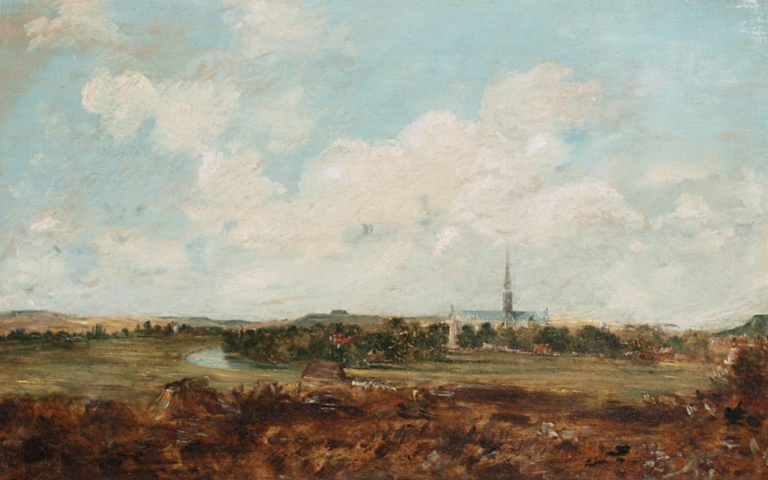
John Constable R.A., A View of Salisbury from Harnham, early 1820s, The Salisbury Museum, Salisbury, UK, on loan from a private collection.
To celebrate the 250th anniversary of John Constable’s birth, Salisbury Museum is exhibiting a rarely seen A View of Salisbury from Harnham, on long-term loan from a private collection. To anyone who knows Constable primarily through the Hay Wain, this is a surprising image. It depicts a very different part of England, painted in a more naturalistic style. Like all Constable’s work, however, it is rooted in on-the-spot observation, personal associations, and love of the countryside.
John Constable (1776–1837) spent his formative years in Suffolk, in the East Anglian countryside. More than most artists, he is associated with this specific location. Even today, Flatford Mill, East Bergholt, and Dedham Vale are known and marketed as “Constable Country,” and thousands of tourists visit each year to see locations that have barely changed since he painted them.
Constable did, however, paint elsewhere. He lived in London after his marriage and sketched on Hampstead Heath. There, he regularly rented a cottage from 1819 and eventually owned a home. He regularly visited Brighton during the 1820s to try to ease his wife’s tuberculosis, and he painted beach scenes there.
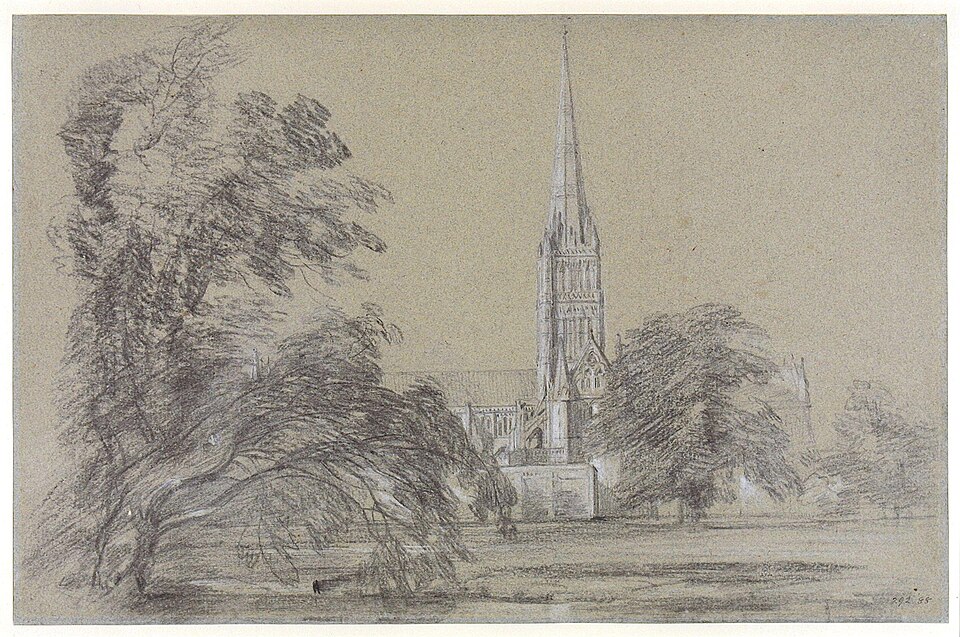
John Constable R.A., Salisbury Cathedral: Exterior from the South-West, 1811, Victoria and Albert Museum, London, UK.
Constable first visited Salisbury in 1811. He continued to spend extended periods there for the rest of his life, producing over 300 works of art of the cathedral and the surrounding countryside. It is possible to track the artist’s entire career through these works.
One of his first drawings of the cathedral, precisely dated September 11–12, 1811, renders its architectural details in precise chalk, using the aesthetic language of the 18th century: picturesque. Later, Constable would produce rapid sketches of seemingly inconsequential views of the countryside. Cottage and Trees near Salisbury is dated with equal precision—July 28, 1829—but the interest now is on light and atmosphere.
Alongside these, he painted oils like View from Harnham: small, sellable landscapes that eschew well-known beauty spots in favor of naturalistic views of the countryside.
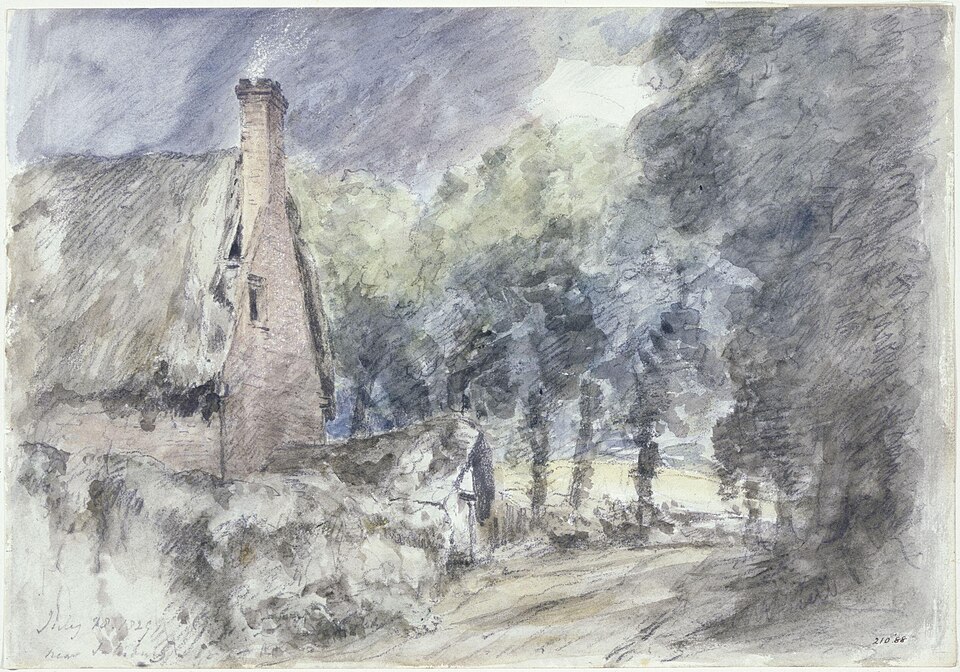
John Constable R.A., A Cottage and Trees near Salisbury, 1829, Victoria and Albert Museum, London, UK.
Constable’s visits to Salisbury were a direct result of his friendship with two churchmen, both called John Fisher. The elder Fisher knew Constable as a young man when Fisher was Rector of Langham, a parish bordering East Bergholt. The rector was a keen amateur artist, and the two men remained close after he became Bishop of Salisbury in 1807. Fisher was a significant patron, notably commissioning two views of the cathedral: one for his daughter, and one which included himself and his wife in the foreground.
The bishop’s nephew was also a lifelong, very close friend of the artist. This Fisher later became an archdeacon at Salisbury. He officiated at Constable’s wedding and hosted him on his honeymoon at Osmington in Dorset. Constable sought consolation from Fisher and Salisbury after the death of his wife in 1828. The two men wrote regularly, exchanging views on religion, science, and history.
Perhaps most importantly, the younger Fisher bought many of Constable’s most significant works, including three of his “six footers,” giving the artist much-needed financial stability. Constable’s Salisbury Cathedral from the Meadows (below) can be seen as a tribute to Fisher, whose home sits at the foot of the rainbow.
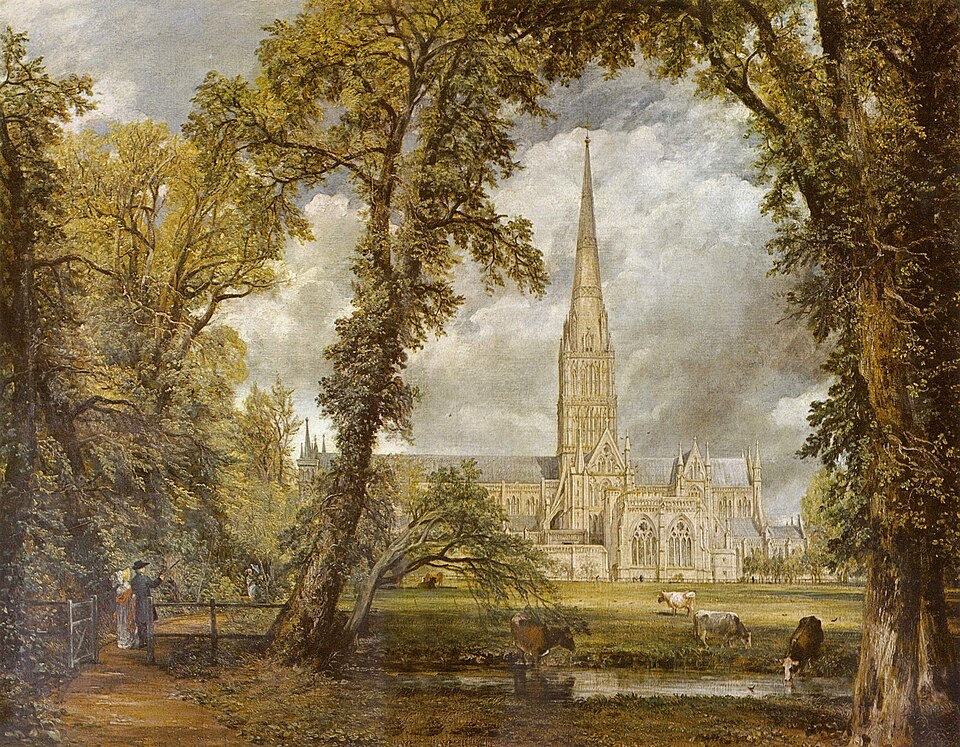
John Constable R.A., Salisbury Cathedral from the Bishop’s Grounds, 1823, Victoria and Albert Museum, London, UK.
Unlike many other landscapists of the time, notably J. M. W. Turner, Constable did not seek out new and exciting scenes. He did not travel abroad, and after an early, and not particularly happy, trip to the Lake District, he seems to have had little interest in visiting other parts of the United Kingdom.
Nostalgia for childhood haunts, like his father’s mill where he worked as a teenager, sustained much of his work. Equally, Salisbury is not simply a convenient subject, but a deeply meaningful repository of feeling. The place mattered to him.
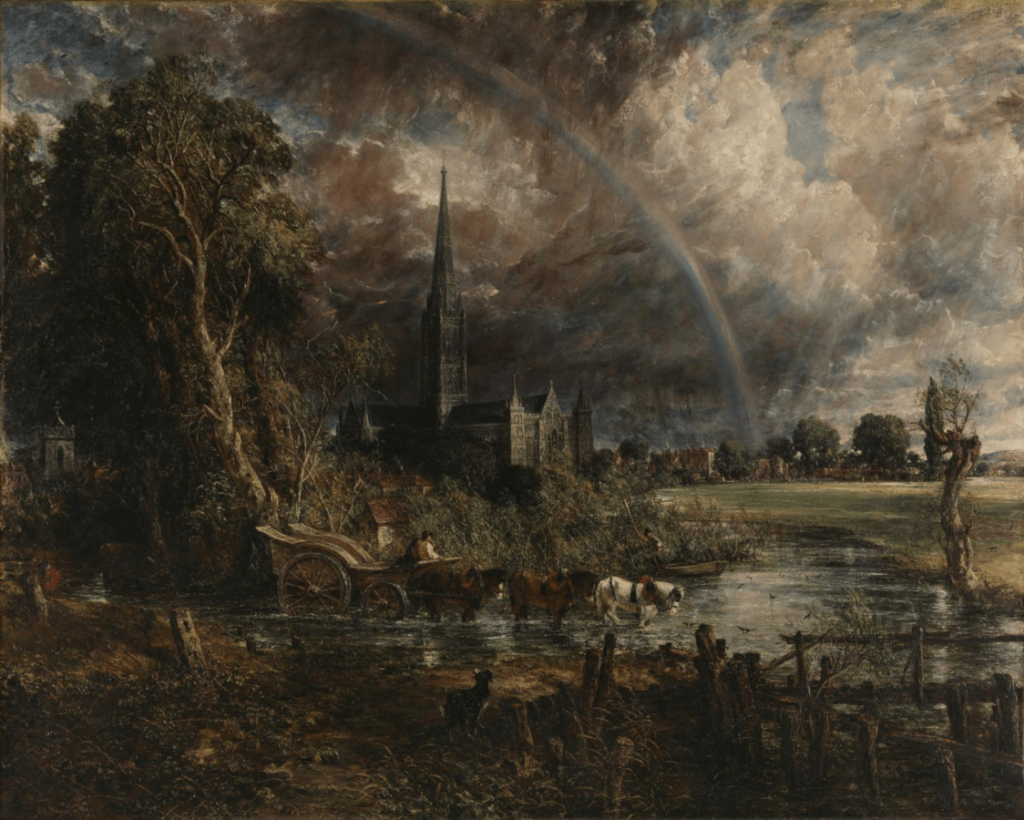
John Constable R.A., Salisbury Cathedral from the Meadows, c. 1831, Tate Britain, London, UK.
Constable was a deeply religious man, and many of his Salisbury paintings focus on the cathedral itself. The Gothic architecture of the building is a man-made creation that mimics the pattern of God-created trees. These trees form their own Gothic arches in Salisbury Cathedral from the Bishop’s Grounds. In Salisbury Cathedral from the Meadows, the whole structure is bounded by a rainbow, the spire haloed in light, breaks through the stormy clouds.
God is present throughout Constable’s landscapes in more subtle ways, too. Look into the distance of most and you can see a church. In the case of A View of Salisbury from Harnham, the famously tall spire of Salisbury Cathedral pierces up toward heaven from the flat fields until it seems to dissolve into the clouds. It is not the subject of the painting, not even the focal point, but it serves as a gentle reminder that God and the church are integral to Constable’s worldview.
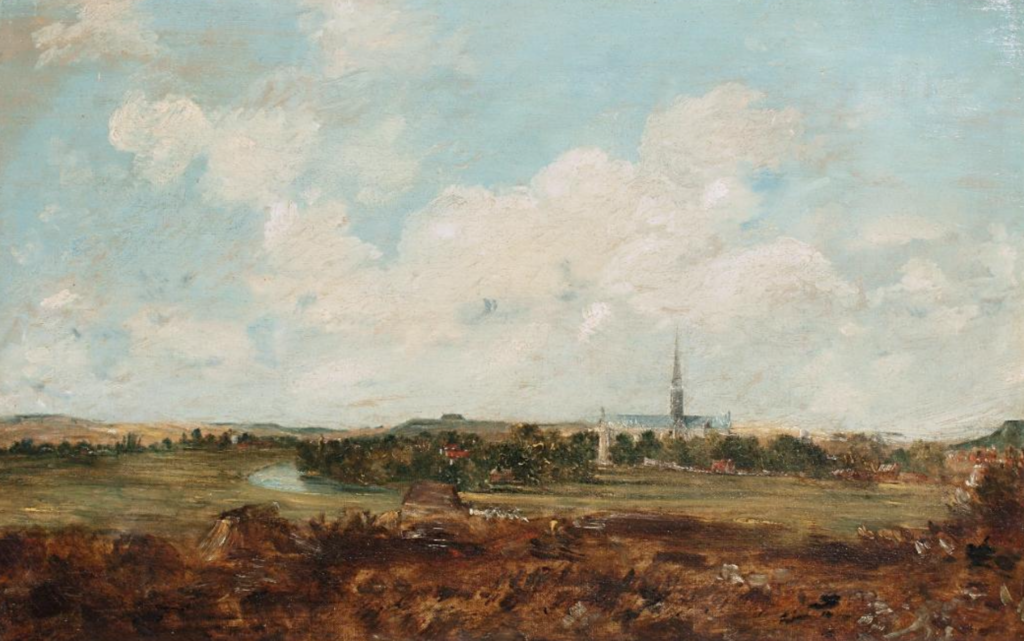
John Constable R.A., A View of Salisbury from Harnham, early 1820s, The Salisbury Museum, Salisbury, UK, on loan from a private collection.
God is also reflected in the importance Constable places on the sky in his works. In the flat expanse of A View of Salisbury from Harnham, almost two-thirds of the canvas is given over to it, making the earth seem almost insignificant. A View of Salisbury from Harnham was painted during the 1820s when Constable increasingly explored the sky through cloud studies that recorded specific weather and seasonal conditions quickly and on the spot. In many of these sketches, Constable looks almost entirely heavenward, with perhaps only a snatched branch to bring the earth into view.
Constable was interested in meteorology and science. He described the sky as “the chief organ of sentiment”—the way to generate emotion in his painting. At the same time, however, he saw all nature as created by and gifted by God. Looking at the scudding clouds and the hint of pinkish warmth in A View of Salisbury from Harnham, it is Constable’s handling of the sky that gives the work its believable naturalism. It is the sky that really attracts the viewer’s attention.
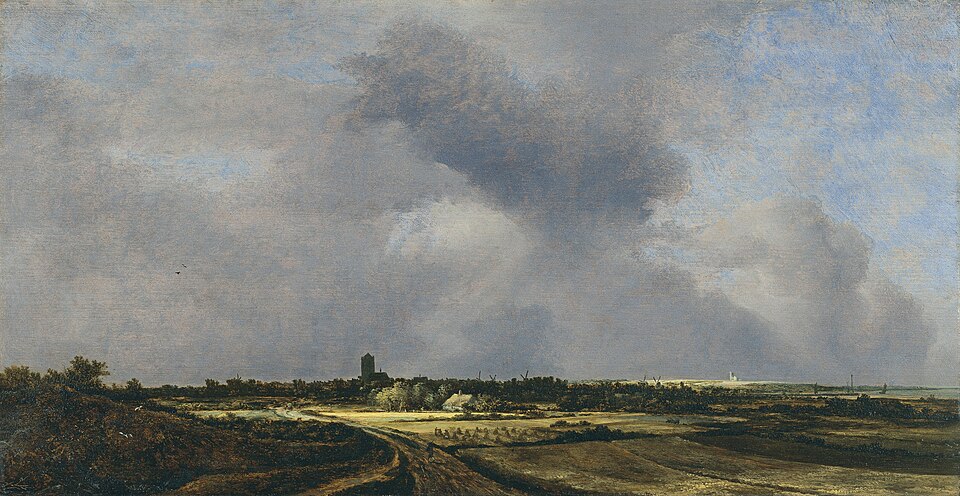
Jacob van Ruisdael, View of Naarden, 1647, Thyssen-Bornemisza Museum, Madrid, Spain.
Constable’s choice of flat landscape and big sky also demonstrates his awareness of the Dutch landscape. While many of his contemporaries were exploring the classical landscape tradition, exemplified by Claude Lorrain, or looking toward Romantic ideas of the sublime, Constable was drawn to the work of 17th-century artists, like Jacob van Ruisdael.
Dutch artists favored contemporary scenes featuring farm animals and working figures, windmills, and waterways, exactly the subjects that appealed to Constable. The similarities between A View of Salisbury from Harnham and Ruisdael’s View of Naarden are obvious, from the expansive sky and the tower on the horizon to the middleground patch of light and the empty foreground.
However, the differences are significant. Ruisdael employs a level of finish and compositional control that Constable resists. Ruisdael leads us into the canvas with careful diagonals, which are even mirrored in the line of the clouds. We know where to go and what to look at, and we can see every detail from the cottages to the stooks of corn in the fields.
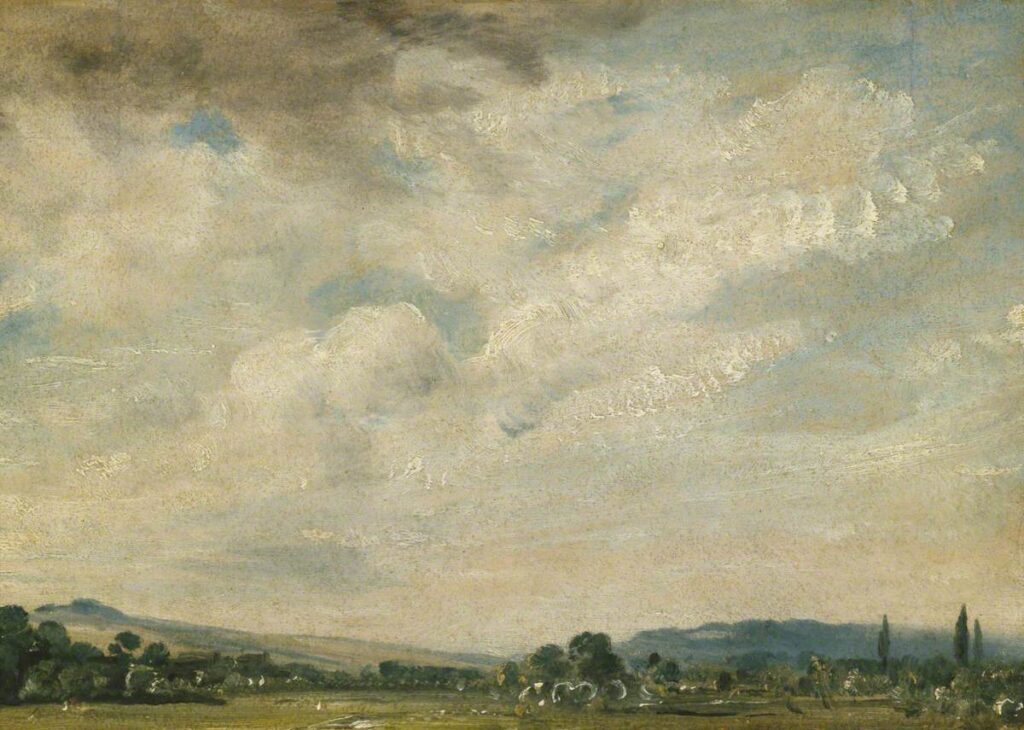
John Constable R.A., Harnham Ridge, Near Salisbury, Upton House, National Trust, Warwickshire, UK.
Constable frequently worked outdoors. In his early career, he experimented with working on large canvases outside, but the difficulties were enormous. Instead, he developed a practice of making plein-air sketches that could then be reworked in his studio, as he tried to juggle his desire to produce living, naturalistic scenes with the expectations of the public and members of the Academy.
Harnham Ridge, Near Salisbury, an oil sketch on paper, was painted outdoors in a similar area to A View of Salisbury from Harnham. There is even greater emphasis on the turbulence of the sky. The foreground vegetation is barely more than a swirl of brushstrokes. Likewise, Constable makes no effort at all to represent a “subject,” for instance, with the inclusion of the cathedral. This is simply a random piece of countryside recorded on a particular day.
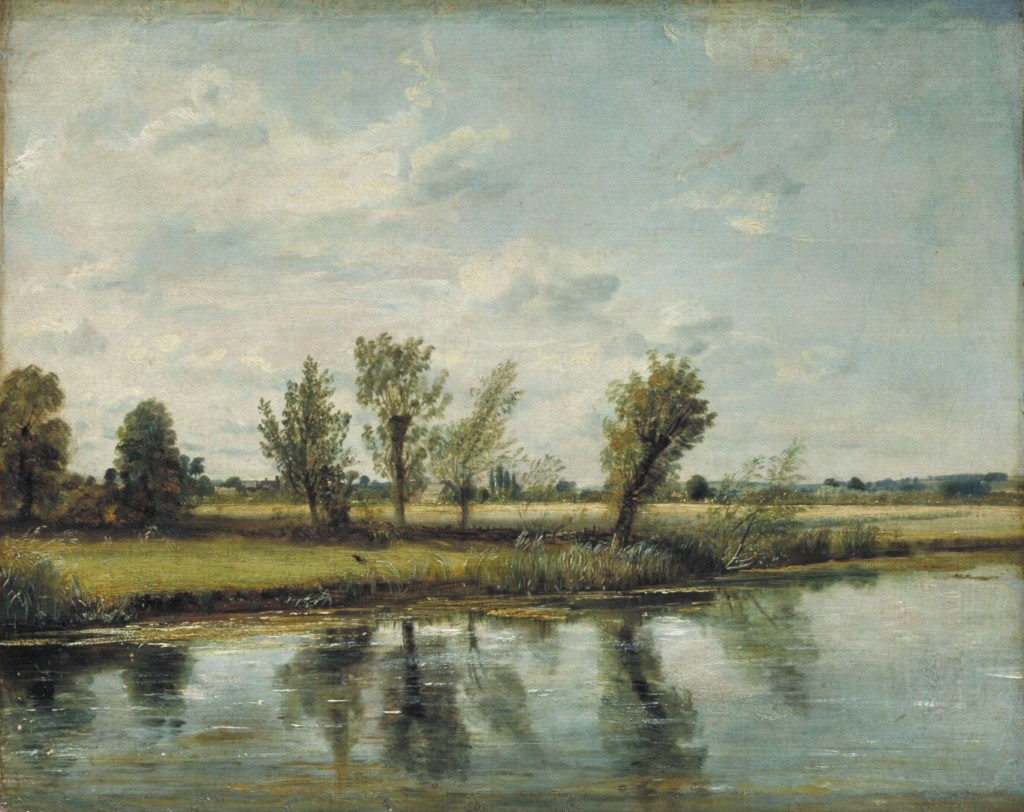
John Constable R.A., Water Meadows near Salisbury, c.1829, Victoria and Albert Museum, London, UK
In 1829, Constable submitted Water Meadows near Salisbury to the Royal Academy, only to have the embarrassment of the hanging committee (of which he was a part) criticize it for being “a nasty green thing.” The incident exemplifies the dilemma Constable faced. There is no central focus to this landscape, little to guide the eye, and almost nothing to generate picturesque interest. The naturalistic color and sketchy finish are at odds with contemporary expectations of what a landscape painting should be.
Instead, Constable gives us a believable view of an average stretch of countryside on a very average British day, painted loosely, and at least partly outdoors, to evoke life and movement. It is also a scene which was much loved by, and very familiar to the artist, painted from John Fisher’s garden.
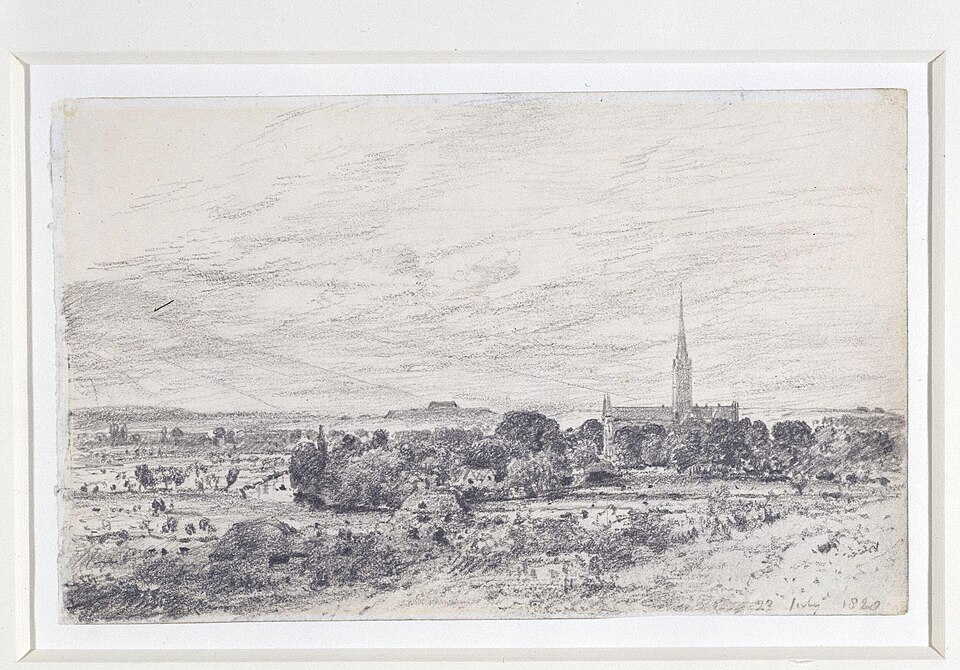
John Constable R.A., Salisbury from the South, c. 1820, Victoria and Albert Museum, London, UK.
A pencil drawing, View of Salisbury from the South, depicts a very similar scene to A View of Salisbury from Harnham and exemplifies how Constable would have used outdoor sketches to develop his finished oils. The drawing gives greater attention to the vegetation and has a more intimate sense of perspective, bringing us much closer to the cathedral on the horizon.
There are also two oil versions of A View of Salisbury from Harnham, both of a similar size and date; the second is in the Louvre. Constable often produced duplicate paintings, intending to sell one and keep the other. It is a practice that suggests his deep personal attachment to his work.
The two paintings are superficially very alike, with identical positioning of the cathedral, the flat hill of Old Sarum to the left, and the visible bend of the river. However, the mood of each is very different. The sky in the Louvre painting is more overcast, with no sense that the sun could break through the clouds. It is a chillier day, which casts a cooler palette over the foreground landscape. At the end of the 19th century, Claude Monet would produce multiple versions of the same scene. Here, Constable is already demonstrating that no two views of nature can ever be alike.
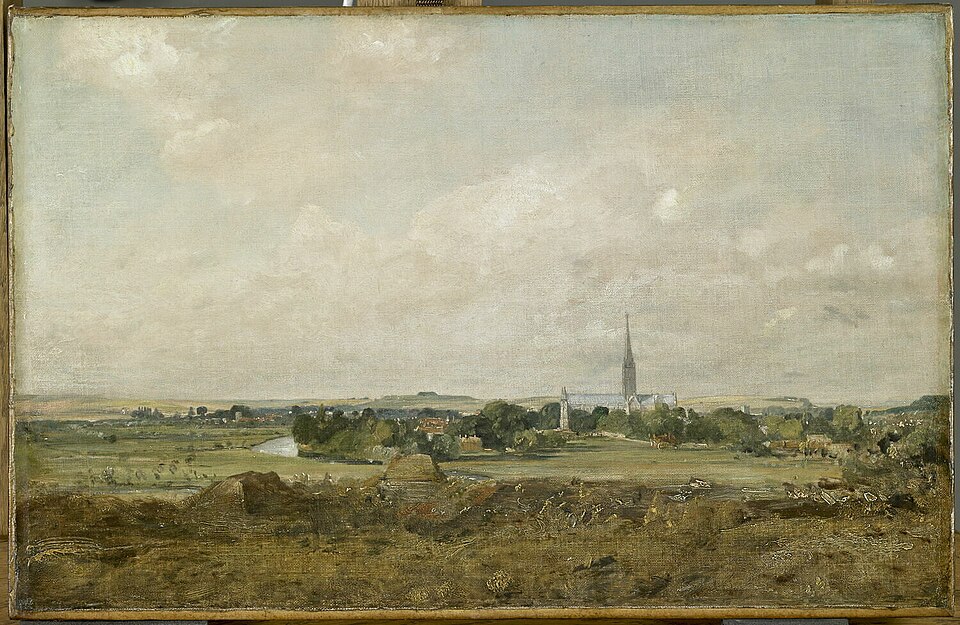
John Constable R.A., View of Salisbury, 1820, Louvre, Paris, France.
John Constable is often mistakenly pigeon-holed as a painter of large-scale, slightly idealized views of the East Anglian countryside. His Salisbury paintings show him to be a painter of greater range, and his A View of Salisbury from Harnham positions him firmly as a painter of observed landscape. In it, we see an artist working within a Dutch tradition yet looking forward to the plein-air naturalism of the later 19th century.
A View of Salisbury from Harnham is on display at the Salisbury Museum from June 11, 2026.
Get your daily dose of art
Click and follow us on Google Profile

DailyArt Magazine needs your support. Every contribution, however big or small, is very valuable for our future. Thanks to it, we will be able to sustain and grow the Magazine. Thank you for your help!

Catriona Miller is an art historian and freelance writer on art. Having studied at Oxford and St Andrews, she is currently researching issues of nationalism and identity in British landscape painting. She has taught art history and lectures on art history and art appreciation.

Coffee-fueled writer, artist, and daydreamer.
Can paintings play a role in rebuilding a city? In the case of Warsaw, the answer is a resounding “yes!” Without the meticulous precision...
The Royal Castle in Warsaw 25 May 2026
The Gemma Augustea is the second largest cameo surviving from antiquity, and one of the most artistically valuable pieces of ancient Roman art. It is...
James W Singer 17 May 2026
Around 1917, the Mexican painter Germán Gedovius created La Tehuana (Woman from Tehuantepec), a warm and intimate moment between a mother and her...
Jimena Escoto 10 May 2026
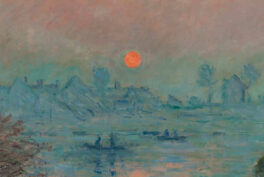
Sunset on the Seine at Lavacourt, Winter Effect by Claude Monet is an Impressionist masterpiece filled with the cold of winter and the sadness of...
James W Singer, 3 May 2026

_by_John_Constable,_Tate_Britain.JPG#/media/File:Flatford_Mill_(Scene_on_a_Navigable_River)_by_John_Constable,_Tate_Britain.JPG)


_-_Hampstead_Heath_-_PD.207-1948_-_Fitzwilliam_Museum.jpg#/media/File:John_Constable_(1776-1837)_-_Hampstead_Heath_-_PD.207-1948_-_Fitzwilliam_Museum.jpg)
