

Advertisement
Women Artists

Tribute to Yayoi Kusama—The Polka Dot Queen

Katerina Papouliou 27 August 2026 min Read

Yayoi Kusama, one of the world’s most-celebrated contemporary artists, died at the age of 97. “It is with profound sorrow that the passing of Yayoi Kusama at a hospital in Tokyo on August 14, 2026”—reads the statement on the artist’s official website.

Kusama, often referred to as the Queen of Polka Dots, was a pioneering feminist artist, sculptor, performer, and much more—all embodied in one extraordinarily talented individual. She was one of the most significant figures in contemporary and pop art. Kusama was renowned for her conceptual approach, which explored themes of feminism, anti-war sentiments, and personal experiences. From 1955 onward, she contributed a remarkable array of masterpieces to the art world. But who was Yayoi Kusama, really? Join us as we explore her imaginative universe through 10 of her unique works!

1. An Artist Born in Flowers

Yayoi Kusama artworks: Yayoi Kusama, Lingering Dream, 1949, Yayoi Kusama Museum, Tokyo, Japan.

Yayoi Kusama, Lingering Dream, 1949, Yayoi Kusama Museum, Tokyo, Japan.

Yayoi Kusama was born in 1929 in Matsumoto, a small town in Japan. She was the youngest of four children in a wealthy family that operated a plant nursery. From a young age, she aspired to be a painter and began creating art at the age of 10, often incorporating polka dots, which would later become her signature. Although Kusama’s family wanted her to become a traditional housewife, she persuaded them to allow her to study at Kyoto City University of Arts for a year, focusing on a traditional Japanese painting style called nihonga. This experience helped her dreams take shape.

From the point of view of one who creates, everything is a gamble, a leap into the unknown.

Yayoi Kusama

Kusama: Infinity, directed by Heather Lenz, 2018, Magnolia Pictures.

Kusama’s artistic motivation primarily stemmed from the hallucinatory experiences and visions she encountered during her childhood, which overflow from her inner world. Her early works, such as 1949’s Lingering Dream, often depict flowers that seem poised to engulf the viewer. This imagery reflects her traumatic experiences in the flower fields of her family’s business. Initially, she created her artwork using pigment on silk or oil on canvas, but after World War II, she shifted to using jute seed bags or cardboard for their precision.

Yayoi Kusama artworks: Georgia O’Keeffe, Black Iris, 1926, Metropolitan Museum of Art, New York, USA.

Georgia O’Keeffe, Black Iris, 1926, Metropolitan Museum of Art, New York, USA.

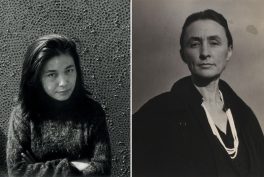
In 1952, she held her first solo exhibition at the First Community Center in Matsumoto. Three years later, she sent her works to the United States and participated in the International Watercolor Exhibition. During the same year, she wrote a letter to the American artist Georgia O’Keeffe, the creator of one of Kusama’s favorite pieces, Black Iris. O’Keeffe replied, and her encouragement had a profound impact on Kusama’s life. In 1957, Kusama turned down several marriage proposals, burned 2,000 of her works, and made the bold decision to move to New York City.

2. Infinity Nets in the Big City

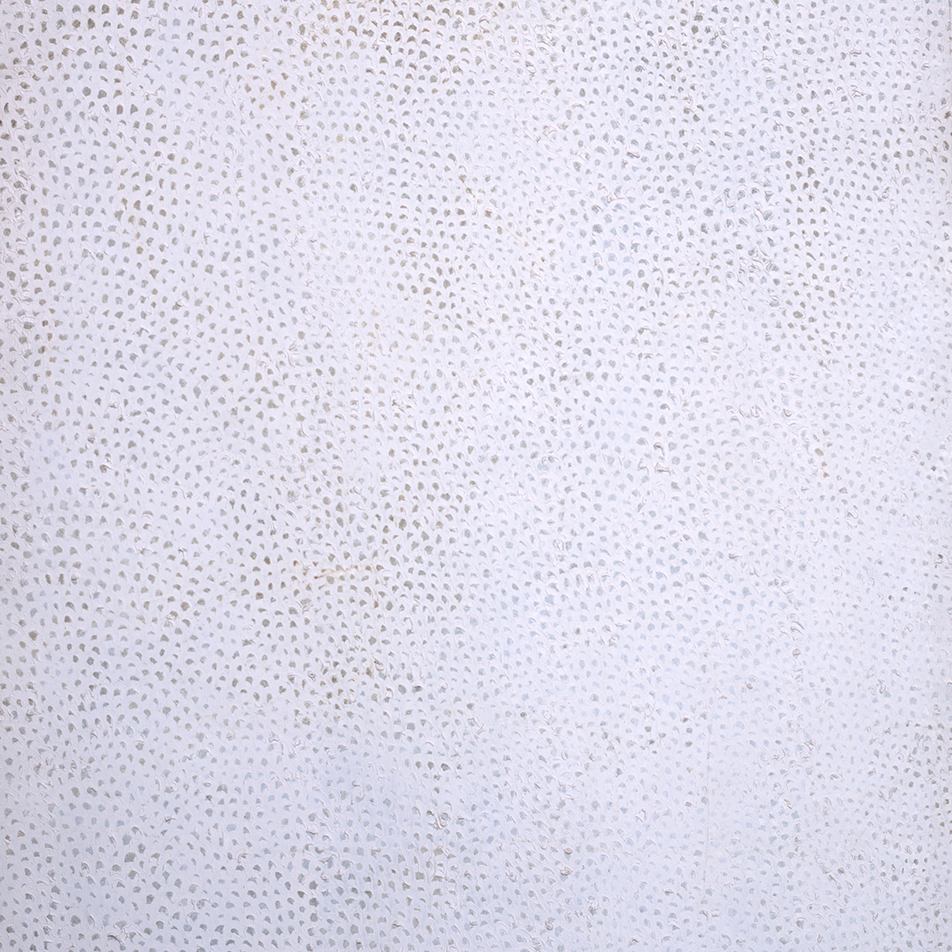
Yayoi Kusama artworks: Yayoi Kusama, Infinity Nets (2), 1958, Yayoi Kusama Museum, Tokyo, Japan. Detail.

Yayoi Kusama, Infinity Nets (2), 1958, Yayoi Kusama Museum, Tokyo, Japan. Detail.

In the summer of 1958, Kusama arrived in New York with a promise to herself: she would change the world of art. In the bustling city, she developed close relationships with several notable artists, including Georgia O’Keeffe, Andy Warhol, Donald Judd, and Joseph Cornell, with whom she shared a platonic love affair.

Yayoi Kusama artworks: Yayoi Kusama and Joseph Cornell in Westhampton, 1971, New York City, NY, USA. M+ Magazine.

Yayoi Kusama and Joseph Cornell in Westhampton, 1971, New York City, NY, USA. M+ Magazine.

Yayoi Kusama dedicated herself to establishing her identity as an artist in a field predominantly occupied by white male artists. Her first solo exhibition was held at the Brata Gallery and the Nova Gallery in 1959, where she presented her Infinity Nets paintings. These works received positive reviews and were inspired by the waves of the Pacific Ocean, which she admired during her travels from Japan to New York.

I work as much as 50 to 60 hours at a stretch. I gradually feel myself under the spell of the accumulation and repetition in my “nets” which expand beyond myself, and over the limited space of canvas covering the floor, desks, and everywhere; all of the universe which is actually visible.

Yayoi Kusama

The Life of Yayoi Kusama. A Visual Chronology, M+ Magazine.

The paintings resemble tapestries with a wonderful tactile quality, featuring a repeating pattern. The earliest pieces in this series, such as Infinity Nets (2), were created in black and white, while later versions included vibrant colors like yellow, red, and blue. The largest painting in this series measures an impressive 10 meters in length.

Yayoi Kusama artworks: Yayoi Kusama in front of her 10-metres-long Infinity Net painting at Stephen Radich Gallery, 1961, New York City, NY, USA, M+ Magazine.

Yayoi Kusama in front of her 10-metres-long Infinity Net painting at Stephen Radich Gallery, 1961, New York City, NY, USA, M+ Magazine.

3. Installation: Her Soft Sculptures

AdVertisment

As a child, Yayoi Kusama worked in a military factory during World War II, where she made parachutes. The skills she acquired in textile manufacturing led her to create a series of soft sculptures in the early 1960s. These sculptures were known for their white, polka-dotted patterns and were attached to various objects. One of her early works is an armchair titled Accumulation, created in 1963.

If there is a chance that in 100 years’ time, there will be just one person who will look at my work and be touched by it, then I must continue to create art for that person.

Yayoi Kusama

The Life of Yayoi Kusama. A Visual Chronology, M+ Magazine.

In December 1963, Yayoi Kusama created an immersive installation titled Aggregation: One Thousand Boats Show at the Gertrude Stein Gallery in New York. This installation featured a central boat, complete with oars, covered in soft white sculptures of phalluses. Surrounding the boat were 999 screen prints of the same sculpture, creating a dizzying and repetitive effect. Two years later she created the Infinity Mirror Room-Phalli’s Field, which was filled with mirrors and soft sculptures of polka-dotted phalli.

AdVertisment

These works were particularly innovative, inspiring many artists. Andy Warhol created the Cow Wallpaper, while Claes Oldenburg experimented with his first soft sculptures, including Calendar. Although Kusama set the standard for these styles, she received significantly less fame than Warhol and Oldenburg.

4. Narcissus Garden in Biennale 1966

AdVertisment

In 1966, Yayoi Kusama participated in the 33rd Venice Biennale without an official invitation or an invitation from a country. Her installation, titled Narcissus Garden, featured 1500 mirror balls displayed on the grass outside the Italian pavilion. Wearing her kimono and later a red leotard, she sold her artwork for just a few dollars.

5. Anti-war and Other Performances

AdVertisment

Between 1967 and 1969, Yayoi was particularly active in performances. In 1967, she collaborated with director Jud Yalkut to create the film Self-Obliteration, which showcased her artistic works and perspective on the world. During this period, she staged numerous performances featuring nudity that highlighted themes of activism and anti-war sentiments, including Anatomic Explosion on Wall Street. Additionally, Yayoi conducted various happenings centered around the theme of unrestricted love. In fact, in one of these happenings, she performed the first homosexual wedding in 1968.

6. Back to Japan: Collage Period

Yayoi Kusama artworks: Yayoi Kusama, Now That You Died, 1975, Setagaya Art Museum, Setagaya, Japan. M+ Magazine.

Yayoi Kusama, Now That You Died, 1975, Setagaya Art Museum, Setagaya, Japan. M+ Magazine.

Kusama gradually lost the respect she once held in America, facing harsh criticism for her works, especially her interpretations of nudity. Following Nixon’s victory, which ushered in a wave of artistic conservatism favoring white male artists, she returned to Japan in 1973. There, she struggled as an unknown middle-aged artist with a controversial past. Her psychological state worsened with the deaths of Joseph Cornell and her father, leading her to create works that focused on themes of death and war, primarily through collages.

7. The Return of the Colors

Yayoi Kusama artworks: Yayoi Kusama, Imagery of Human Beings, 1987, Lito and Kim Camacho Collection. M+ Magazine. Detail.

Yayoi Kusama, Imagery of Human Beings, 1987, Lito and Kim Camacho Collection. M+ Magazine. Detail.

In 1977, she entered a psychiatric clinic in Tokyo, where she resided until her death and ran her workshop. This marked a revival of her artistic career, with her works becoming vibrant once again. By 1982, she was exhibiting at the Fuji Television Gallery in Tokyo. In 1989, she had her first solo exhibition in years at the Center for International Contemporary Arts in New York, titled Yayoi Kusama: A Retrospective. Her significant comeback was highlighted by her solo exhibition at the Venice Biennale in 1993, where she represented Japan.

AdVertisment

8. Her Eternal Love: Polka-Dots Pumpkins

AdVertisment

Yayoi Kusama’s lifelong connection to pumpkins began in her childhood. She admired their “humorous form, warm feeling, and human-like quality,” finding safety in them. In 1993, the Infinity Room presented at the Venice Biennale featured yellow polka dot pumpkins, and she even offered extra ones as takeaways for visitors.

Our earth is only one polka dot among a million stars in the cosmos. Polka dots are a way to infinity. When we obliterate nature and our bodies with polka dots, we become part of the unity of our environment.

Yayoi Kusama

Who is Yayoi Kusama? Tate.

9. Infinity Rooms, Infinity World

AdVertisment

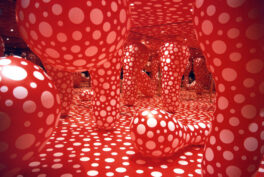
Yayoi Kusama’s Infinity Mirror Rooms break down the boundaries of space and perspective. Her first, created in 1966, was an octagonal room of mirrors and lights with openings for viewers’ heads, evoking the universe. Subsequent installations also featured mirrors, colorful lights, and various objects, heightening the feeling of infinity.

10. The Hall of Fame

Yayoi Kusama artworks: Yayoi Kusama, Every Day I Pray For Love, 2021, Yayoi Kusama Museum, Tokyo, Japan. Museum’s website.

Yayoi Kusama, Every Day I Pray For Love, 2021, Yayoi Kusama Museum, Tokyo, Japan. Museum’s website.

After participating in the 45th Venice Biennale, Kusama regained her fame from the 1960s, achieving even greater success. Her solo exhibitions increased significantly, including the notable Love Forever: Yayoi Kusama, 1958–1968 exhibition at the Los Angeles County Museum of Art in 1998. She later established a permanent exhibition at the Matsumoto City Museum of Art and showcased her works in major institutions worldwide. In 2012, she collaborated with Louis Vuitton to create a clothing and accessories line. The Yayoi Kusama Museum opened in Tokyo in 2017, housing many of her works and marking the culmination of her artistic career.

I want younger people, or everyone, to talk about my enthusiasm reaching to space and also, my art as a token of my life even after my death. For that reason, I worked all this morning. I’d like to keep creating art until the day I die.

Yayoi Kusama

An Introduction to Yayoi Kusama, Tate.

Yayoi Kusama was recognized as one of the most successful contemporary artists. Each year, she drew a large number of visitors to her exhibitions, solidifying her status. Until her death, she continued to create, aiming to share love, hope, and peace with the world. Her death came just before the opening of her landmark retrospective at the Stedelijk Museum Amsterdam.

Yayoi Kusama exhibition runs at the Stedelijk Museum Amsterdam, Netherlands, from September 11, 2026 until January 17, 2027.

Bibliography

1.

Alex A. Jones: “The Life of Yayoi Kusama”, A Visual Chronology, M+ Magazine. Accessed 15 Dec. 2024.

2.

An Introduction to Yayoi Kusama, Tate Modern. Accessed 15 Dec. 2024.

3.

Karen Kedmey: “Yayoi Kusama“, MoMa. Accessed 15 Dec. 2024.

4.

Yayoi Kusama Exhibition, Yayoi Kusama Museum. Accessed 15 Dec. 2024.

5.

Yayoi Kusama, Ota Fine Arts. Accessed 15 Dec. 2024.

6.

Hal Foster et al: “Art Since 1900”, Modernism, Antimodernism, Postmodernism, 2018, Thames & Hudson Ltd, London, UK, pp. 576-80, 578, 843.

7.

Kusama: Infinity, directed by Heather Lenz, 2018, Magnolia Pictures.

Recommended

Women Artists

Rolinda Sharples—Jane Austen’s Contemporary Who Painted Britain’s Changing Society

Rolinda Sharples painted the world of Jane Austen, and the political turmoil unfolding beyond the ballroom. Her paintings capture Regency society as...

Guest Author 31 August 2026

Women Artists

Blanche Hoschedé-Monet: The Successful Painter History Remembered as Monet’s Stepdaughter

She was photographed beside Claude Monet in his garden at Giverny. She was called “the blue angel” by Georges Clemenceau. She is remembered as...

Guest Author 30 July 2026

Women Artists

Hidden Places to See Celebrating Women Artists in Bologna

Bologna, in northern Italy, fostered more women artists in the early modern period than any other European city. Nowhere else matched the number, the...

Kitty Perring 10 August 2026

Women Artists

Amrita Sher-Gil in 10 Paintings—The Artist Who Reimagined Modern Indian Art

When Amrita Sher-Gil died in Lahore in December 1941, she was only 28 years old. Yet in little more than a decade, she transformed the course of...

Shivani Gupta 10 August 2026

Advertisement